

Author Archive

How do I get started with an online blog? (Part 1 of 2)

Posted March 2, 2017 By Frank Strona

This is one of the more common questions I get from friends and clients and can often be the simplest or the hardest one I get to respond too. In short; that all depends on what you are hoping to do. So instead of trying to promote and navigate you to any one platform; I will offer you a few of my top 10 initial questions and thoughts on what to consider and then include some supporting links that I have relied on over the years. Some of these points I can’t answer for you and they just need to sit in your head until you feel comfortable with them. While others I can offer you my insight or thinking on them.

Today’s post covers the follow themes:

  • Ask yourself; Why you want a blog?
  • What do you want to blog about?
  • Do you intend to be a “Content/Media creator”, “Content/Media pusher” , “Media voyeur ” or philosophical thinker?
  • What platforms do I use and why?

For tomorrow’s “part two” I will share my thoughts on these themes:

  • Who is your audience?
  • What is your budget?
  • Who else will need access with it and what membership needs might you have to include?
  • How will you go about getting support?
  • How will you promote it?
  • What other social media platforms and integration do you want to consider?

(ed note: Over the course of drafting this I realized it was longer than I intended so I have broken it into two posts, going live over two days.)

  • Ask yourself; Why you want a blog?
    • What will make your blog different from other out there?
    •  Will your blog also serve as a website or will it need to integrate with one (or will you need that too?)
  • What do you want to blog about?
    • How often are you willing to update it?
    • Richard Brownell from PRNews had a great list of “thinking bullets” with his “Ten Rules” that I shared in January 2016 (his original list is no longer online).
  • Do you intend to be a “Content/Media creator”, “Content/Media pusher” , “Media voyeur ” or philosophical thinker?
    • This is one of the “Big Thinker” questions. One of the discourses that seems to come around from time to time is the difference between those who are “create “, meaning they are making and original thought, generated from insight, experience, knowledge, experience etc. Then there are those who prefer to “push”; these are the folks who like to simply share out items that they find interesting or timely. The third group is a hybrid. they tend to see something, then perhaps build on the thinking, sharing and including content, sometimes adapting or offering alternative ways of looking. Each of us, has to decide where we lie on the spectrum. I tend to move around based on my time and what else is happening; but feel that the more original and creative my content it- the stronger the impact and response I get.
    • Media Creators –  they tend to be original thinker’s who like to put out content that is fashioned as new, innovative or share fresh perspective.  They may like to express themselves and thoughts openly and publically and because of that are willing to take the occasional hit from critics on those opinions. Other folks are more into the “Media Push” camp – they are folks who like to share controversial or interesting content links with others along with some appropriate side or anecdotal information to frame the content. There is a third group, I call the “Media Voyeur”. This camp of folks tend to like to read many different streams of content, in some cases opposing blogs and prefer to contemplate the content and either process it verbally in day to day conservations or in social media outlets that don’t actually link to the original post. And yes – you can be a mashup of any or all three. The real secrete is knowing your style and then finding the tools to act on it.
  • What platforms do I use and why?
    • I have worked with several blogging platforms including WordPress (both WordPress.com and WordPress.org depending on your needs), Drupal, Live Journal, Dreamwidth.org; but seem to come back to WordPress  each time. Some of the new mini and micro blog sites (which can also serve as scaled down websites), which are even simpler to use, often free and have great visual presence include Squarespace.com (is a great design for those who need a strong visual presence  but falls short for me on the written word), Wix.com and Weebly.com (This one I used recently for a small nonprofit because of its template based system and simple navigation). 
    • Another reason I lean towards WordPress is I like the simple and built in use of the Jetpack feature. As it has evolved, JetPack has saved me a huge amount of time managing fixes and offering features that a new user to WordPress may not have the experience to access from the rather massive plugin directory that WordPress offers. Also a strong functional need to understanding the “hosting” process. While I use GoDaddy.com for many of my site hosting needs, WordPress.com users will find that its Pressable service is a pretty intuitive option as well.
    • Now don’t forget you can also use micro-blog platforms as well. These usually fall into the category of limited functionality/feature set but offer lots of flexible and ease of use. Some that come to mind is Tumblr.com, Twitter.com (if your personal blog challenge is to keep it to 140 characters per thought), and Medium (one of the newer blog/storytelling platforms to get a lot of attention of late) Facebook Pages or Groups ( keep in mind that Facebook.com itself was designed for the individual and allows you to create “pages” and “groups” to promote or feature. For instance, I have a Facebook Page for this website that people can follow facebook.com/Mentorsfca which has more open access than say my personal Facebook account does. This allows for Facebook only users to follow and not have to check the blog. Plugins on WordPress.com allow me to cross post directly into Facebook. Here is a link on how to manage your Facebook pages that Facebook offers.
Top 10 Biggest Social Media Websites & Apps

Posted March 1, 2017 By Frank Strona

All you wanted to know about sites & apps in under 10 min!

The Social Media Revolution 2017

Posted February 28, 2017 By Frank Strona

Worth a reminder for those who need it; The Social Media Revolution 2016

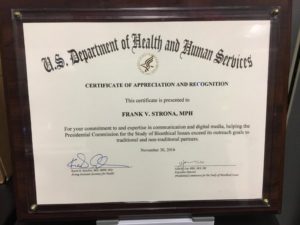
Always nice to be recognized

Posted February 27, 2017 By Frank Strona

A little self-appreciation today; In November 2016, I was awarded presented with a recognition for appreciation for “commitment to and expertise in communication and digital media, helping the Presidential Commission for the Study of Bioethical Issues exceed its outreach goals to traditional and non-traditional partners.”

Overcoming the “label” trap

Posted February 16, 2017 By Frank Strona

We all at times fall victim to trying to live with in a contract of a “label”. Its how we are taught – it shapes and is shaped by our view of school, love, religion, success, family and so on. But, its important to also realize that success and a “life well lived” also is one that expands out beyond the artificial contracts of label and allows for adaptable and fluid self-determined measures for success. When you find yourself struggling to meet some “pre-defined” box or label – seek the an understanding to the “why” and where the true you lies.

This recent PSA was a great reminder that in the end – life and living is about more than labels, titles, greed and money. This isn’t the first PSA that wanted to push the concept of labels – but a good message is always worth a new look.

One of those handy social media “all in one” sheets 

Posted February 13, 2017 By Frank Strona

Sometimes when talking about all the options, you need a quick visual reference to reenforce your talking points. Here is a great one I found from Visualistan. 

Top Social Media Platforms Cheat Sheet #infographicYou can also find more infographics at Visualistan

Visual Media Marketing and Learning; One Take

Posted February 8, 2017 By Frank Strona

3 writing lessons from infographics

Infographics reach 54 percent more readers than blog posts do and can increase content marketing profits by as much as 12 percent, according to Contently. The popular visual format can also teach writers how to improve their content overall. Here are three crossover lessons you can apply to your copy. Below is a snapshot of the post – but for the full posting visit: PRDailey.com


1. Be creative—brainstorm your hook. “The infographics that get attention feature ideas and visuals that no one has ever heard or seen before,” says Karl Gude, a former director of information graphics at  Newsweek and The Associated Press, who now leads the information graphics program at Michigan State University’s School of Journalism.


“There are several techniques you can learn about and use, such as brain writing and random word association,” he says, “but the most important components to being creative are a willingness to think differently, to invest the time it takes and to ensure that a corporate culture of creativity surrounds you.”

2. Keep copy concise. “People can easily fall in love with their content,” “Don’t overwrite, either.”

3. Target audiences with relevant content. “Many people have a ‘one size fits all’ mentality when it comes to infographics,” says Gude. “They work hard to create a single infographic on a topic like, say, lung cancer, and that becomes their go-to graphic to send to everyone.”


Digital trends 2017

Posted February 6, 2017 By Frank Strona

Digital trends 2017: 106 pages of internet, mobile and social media stats Each year creative agency We Are Social delivers its massive annual report about the latest digital trends in internet, mobile and social media usage – and now the company is back with an updated collection of insights and statistics reflecting the world’s most recent web developments in 2017. Teaming up with social media help tool Hootsuite, the agency has crunched data from 238 countries to put together 106 pages of the latest stats and trends in the digital world. 


Digital in 2017 Global Overview from We Are Social Singapore

Not just for kids!

Posted February 5, 2017 By Frank Strona

Caught this one from another list I am on and made me chuckle; Blomberg.com posted Middle-Aged Americans Beat Millennials in Time Spent on Social Media Get off Facebook, Dad. No, really, you’re spending, like, seven hours a week on there. It’s no exaggeration: Despite the popular belief that millennials are the generation most addicted to their phones, a recent report from Nielsen, the media information and analysis company, found that it is, in fact, Generation X that lavishes the most time on social media pages.

According to it’s author, “Gen X spends nearly seven hours a week on social networks, a study finds, more than any other age group.” I imagine given the changing and somewhat “charged” times, we can anticipate that growing for those with a fiscal or political relationship with the web interfaces. Quoting a report from Nielsen.com, “35- to 49-year-olds averaged six hours and 58 minutes. Millennials, defined by the study as those aged 18 to 34, spent 39 fewer minutes per week”

A Facebook related blog posts worth reviewing

Posted February 3, 2017 By Frank Strona

Some interesting Facebook related posts that caught my eye, (note: I am not engaged with any of these sites, simply as I see or read I am sharing)

5 things social media editors should do when programming Facebook Media organizations, repeat after me: Facebook is not made for you. It may adapt somewhat to your presence, but ultimately it’s made for the 1 billion-plus people who are having a conversation on it. If you’re lucky, your story might sometimes be the topic of that conversation; if you’re smart, you’ll be engaged in the discussion, too. Here are five recommendations to help make that happen. [ED NOTE: a good solid read]

Facebook’s Trending topics shift from viral to corroborated news The Trending section will also add a publisher’s headline below each topic name, replacing a tally of how many people are talking about a topic that previously appeared in this spot. Finally, topics will no longer be personalized, but everyone in the same region will now be able to see the same topics.

Facebook boosts longer videos in algorithm change One of the signals Facebook uses to rank videos is percent completion and that signal previously unintentionally penalized longer videos. The revamped signal weights completion percentage more heavily the longer the video effectively removing the accidental penalty. One immediate consequence of the move is longer videos will be more likely to appear in news feeds and shorter videos could see a drop in news feed distribution, although Facebook said it expects the change to be slight.

Facebook is copying Instagram’s copy of Snapchat’s Stories It was only a matter of time. After copying Snapchat’s Stories on Instagram – and then improving on them – Facebook proper is now testing a Stories feature as well. It works pretty much exactly as on Instagram. Open up the Facebook app, and you’ll see a carousel of circular profile photos representing friends’ Stories above your News Feed. Like on Instagram and Snapchat, the Stories disappear after 24 hours, and you’re able to apply a myriad of filters and effects.

Facebook testing News Feed-like ads inside Messenger Ever on the lookout for new revenue streams, Facebook is pushing News Feed-like ads right on to your Messenger screen. Announced today, the test only affects users from Australia and Thailand, for now, but it’d be hard to imagine a scenario where this didn’t go worldwide after the kinks have been worked out. The new ads will appear the users’ most recent conversation. According to the announcement, users will have the option to hide or report ads that are irrelevant or offensive, and they’re designed not to interfere with your conversations.